You are probably not measuring wrong
The standard advice for an ambiguous body shape result is to blame the tape. Stand naturally, do not suck in, measure the narrowest part of the waist, try again. That advice is worth following once. If you have already measured three times, written the numbers down, and still landed between two shapes, repeating the process a fourth time is unlikely to change anything.
A tie is usually not a measurement error. It is a sign that the system being used to sort you has fewer dimensions than your body does. Five categories built from three numbers will always produce a large group of people who sit on a boundary, and sitting on a boundary is not a flaw in how you measured or in how you are built.
This matters because the conclusion people draw from a confusing result is often the wrong one. The useful takeaway is not that your body is unusual or hard to dress. It is that the shortcut you used has a known limit, and there are more informative questions to ask.
Why two calculators disagree about the same body
Most body shape calculators work by comparing your bust or shoulder measurement, waist, and hips, then applying fixed cut-offs. If your hips exceed your bust by more than a set percentage, you are sorted one way. If your waist is smaller than your hips by more than another set percentage, you are sorted another way.
The problem is that those cut-offs are chosen by whoever built the tool, and they are not standardised. One calculator may treat a waist that is 24 percent smaller than the hips as a defined waist. Another may require 25 percent. A person sitting at 24.5 percent will be told they are a rectangle by one site and an hourglass by the next, with identical measurements typed into both.
This is why running your numbers through several tools tends to increase confusion rather than resolve it. You are not getting a second opinion on your body. You are getting a second opinion on where an arbitrary line should sit.
What three measurements cannot see
Bust, waist, and hips describe width at three heights. They say nothing about how those widths are arranged, and arrangement is what actually determines whether a garment works.
The first missing dimension is vertical proportion: the ratio of your torso length to your leg length. This is what decides trouser rise, where a hemline should fall, whether tucking a top helps or shortens you, and whether a dress with a dropped waist reads as elegant or awkward. No mainstream calculator asks for it, largely because it is difficult to measure on yourself.
The second is where weight sits relative to your frame. Two people can record the same hip measurement while one carries it high on the upper hip and the other low on the thigh. The number matches. The clothing that suits them does not.
The third is shoulder line and bone structure. Whether your shoulders are angular or sloped, narrow or square, changes every decision above the waist, and it does not appear in a hip measurement at all. Between them, these three factors explain most cases where the label a calculator produced does not match what you see in a mirror.
Am I a pear shape?
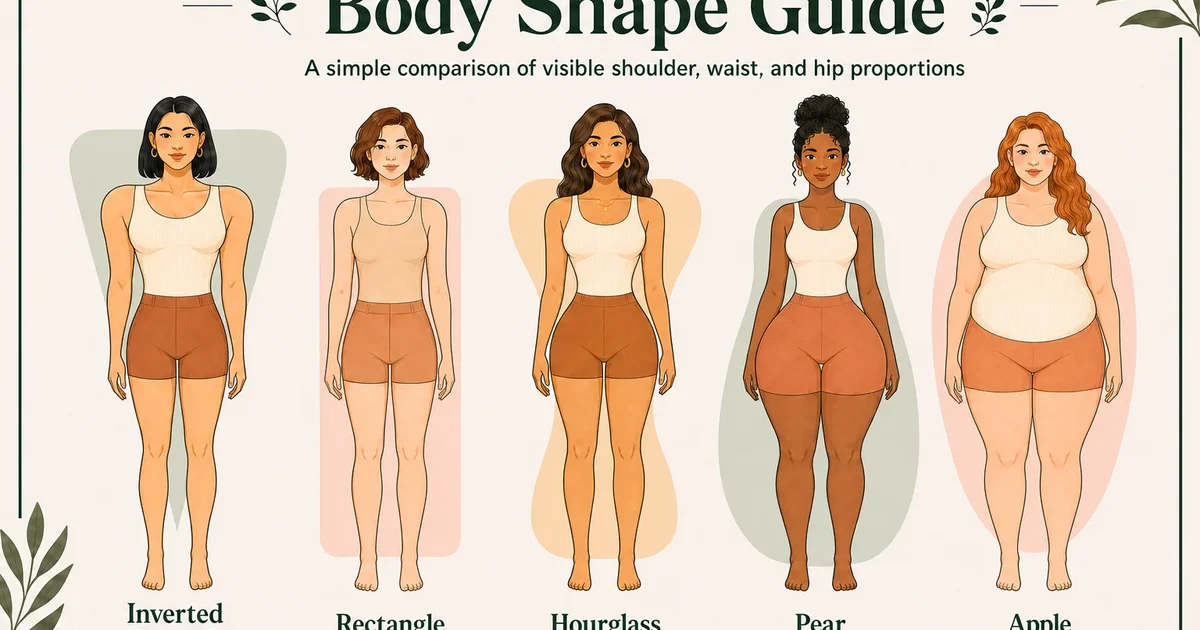
In styling terms, pear usually describes a silhouette where the hips appear clearly wider than the shoulders and bust, with the waist reading as narrower than the hips. The defining feature is the imbalance between upper and lower body, not the presence or absence of a waist.
A quick check: stand square to a mirror and look at where your outline is widest. If the widest point sits at the hips or upper thighs, and your shoulder line falls visibly inside that width, pear is a reasonable starting label. If your shoulders and hips look broadly level, you are more likely looking at an hourglass or a rectangle depending on waist definition.
The most common reason people wrongly reject the pear label is fixating on size rather than proportion. Pear is a description of balance between two halves of a silhouette. It does not describe how large or small either half is, and it is not a permanent classification.
Am I a rectangle or an hourglass?
This is the most common tie, and it comes down to a single judgement: how much waist definition counts as definition. Both shapes assume the shoulders and hips are broadly balanced. The only thing separating them is whether the waist is meaningfully narrower than both.
Because calculators draw that line at slightly different places, people near the boundary get contradictory answers. A more useful test than the arithmetic is a physical one. Fasten a belt loosely around your middle and move around for a moment. If it settles at one point and stays there, you have a waist that garments can find and hold, which points toward hourglass. If it slides up or down, or sits wherever you put it, that points toward rectangle.
The practical difference between the two labels is smaller than it appears. Rectangle styling often works by creating definition through construction, while hourglass styling often works by following definition that is already there. If you are on the boundary, either approach is available, and choosing between them is a preference rather than a correction.
Am I a pear or an hourglass?
People land between these two because both silhouettes usually include a visible waist. The waist is not the deciding factor here, which is why the usual advice about measuring it more carefully does not help.
The deciding factor is whether your upper body balances your lower body. An hourglass reads as balanced at the top and bottom with a narrower middle. A pear reads as narrower at the top than the bottom, whether or not the waist is defined. Two people can have an identical waist-to-hip relationship and belong in different categories entirely because of what is happening at the shoulders.
To check, look only at your shoulder line and hip line and ignore the waist completely. If the two are close to level, hourglass is the better fit. If the hip line is clearly wider, pear is the better fit, and the defined waist you have simply means the pear description needs less adjustment than the standard version assumes.
Am I a rectangle or an apple?
These two get confused because both describe silhouettes without strong waist definition. The difference is where the fullness sits, not whether it exists.
A rectangle reads as broadly straight from shoulders to hips, with the waist neither markedly narrower nor markedly wider than the points above and below it. An apple reads as fullest through the midsection, so the widest part of the torso is at or near the waist rather than at the shoulders or hips.
A side view answers this faster than a front view. Turn side-on to a mirror and look at your profile from ribcage to hip. If the line is roughly vertical, rectangle is the closer description. If it curves outward through the middle and back in toward the hip, apple is closer. Both are descriptions of a current silhouette rather than fixed types, and both can shift with weight distribution, posture, and time.
Two checks you can do in a mirror
The belt test locates your natural waist. Fasten a belt loosely, move around, and let it settle. Where it comes to rest is where garments will naturally sit on you, which is more useful than an inch measurement because it tells you where a waistband, seam, or tie will actually land.
The half-height check estimates vertical proportion. Take your total height, halve it, and find where that midpoint sits on your body. If it falls above your hip joint, your legs make up less than half your height, which indicates a comparatively long torso. If it falls below your hip joint, your legs make up more than half, which indicates a comparatively short torso. That single fact tells you more about which trouser rise and hem length will work than any of the three width measurements will.
Neither test produces a category, and that is the point. They produce information you can act on when buying a specific garment, which is usually what people actually wanted when they opened a calculator in the first place.
When you are genuinely between two shapes
Some people sit on a boundary no matter how the question is asked, and no additional measuring resolves it. In that case the honest answer is that the five-category system has reached its limit, not that you have failed to identify yourself correctly.
The workable approach is to stop looking for the right label and start dressing the specific feature that is most pronounced. If your shoulders are the most defined thing about your silhouette, decisions above the waist matter most. If your waist is, waist placement matters most. If your torso is long relative to your legs, rise and hem length will affect an outfit more than either.
Read the guidance for both of your candidate shapes and keep the advice that appears in both. Where the two disagree, that disagreement is usually about a feature you can check directly using the mirror tests above. This is slower than accepting a label, but it produces better results, because clothing responds to features rather than to categories.
Where a photo helps
A photo can capture things a tape measure cannot, because it records the whole silhouette at once. Shoulder line, the position of the widest point, the relationship between torso and leg length, and whether the outline curves or runs straight are all visible in a single straight-on image and none of them are recoverable from three numbers.
This is the specific gap a photo-based analysis addresses. It does not produce measurements and should not be used for sizing, alterations, or fit. What it can do is compare visible proportions and explain which cues supported the result, which is exactly the information missing when a calculator returns a tie.
If you try it, the same caveats that apply to any single image apply here. Pose, camera angle, lighting, and clothing all change the outline, so a straight-on photo in fitted clothing gives a clearer comparison than an angled one in a heavy layer. Treat the result as a styling starting point that may change over time rather than a permanent classification.
Ready to test your photo?
Use the guide above, then run a private analysis with the free body shape detector. You can also review how the product works and the body shape types before uploading.
FAQ
Can you be two body shapes at once?
Yes, in the sense that many people sit on the boundary between two categories. Body shape systems use a small number of fixed categories to describe continuous variation, so boundary cases are expected rather than unusual. Reading the guidance for both shapes and keeping the advice they share is generally more useful than forcing a single label.
Am I a pear shape if my hips are wider than my bust?
That is the main indicator, though most calculators look for a meaningful difference rather than any difference at all. If your hips are only slightly wider and your shoulders and hips look broadly level in a mirror, hourglass or rectangle may describe your silhouette more accurately depending on waist definition.
Am I an apple or an hourglass?
The deciding factor is where the widest part of your torso sits. An hourglass reads as narrower through the middle than at the shoulders and hips. An apple reads as fullest through the midsection. A side view usually answers this faster than a front view.
Why do two body shape calculators give me different results?
Because the cut-offs they use are chosen by whoever built each tool and are not standardised. One calculator may classify a waist that is 24 percent smaller than the hips as defined while another requires 25 percent, so identical measurements can produce different labels.
Does your body shape change over time?
Yes. Weight distribution shifts with age, hormonal changes, pregnancy, weight change, and training, and those shifts can move you from one styling category to another. A body shape result describes a silhouette at a point in time rather than a permanent type.
What should I do if the calculator result does not match what I see?
Trust the mirror. A calculator compares three widths and cannot account for torso length, shoulder line, or where weight sits on your frame. If the label conflicts with what you observe, the missing dimension is usually one of those three.